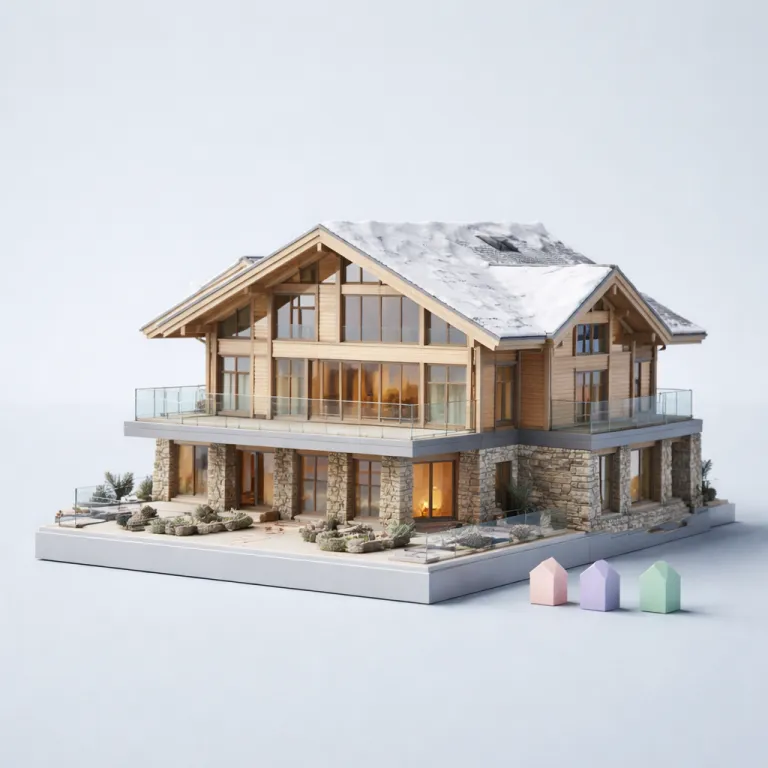

Executive summary. In tightly zoned alpine markets, well‑located luxury mountain homes often move independently of coastal and urban real estate cycles, providing a useful hedge for large estate portfolios. Over the past decade, prime resorts such as Aspen, Vail, St. Moritz and Niseko have combined constrained land supply with resilient tourism demand, supporting both capital values and premium vacation rental income. Climate projections suggest that higher‑elevation, four‑season destinations will increasingly diverge from lower, warmer hillsides. For ultra‑high‑net‑worth owners, the most compelling strategy is to treat each high‑altitude residence as an institutional‑grade asset: resilient location, professional operations, and optionality to compound through adjacent acquisitions.
Why a mountain retreat luxury property behaves like a hedge
A carefully chosen mountain retreat luxury property does not behave like another coastal villa in your balance sheet. In constrained alpine valleys where zoning, avalanche corridors and national park buffers cap new homes, values tend to decouple from broader real estate cycles. When your other houses sit on hurricane exposed coasts or in overheated urban centers, a portfolio of luxury mountain retreats in places such as Aspen, Zermatt or Sun Valley can quietly stabilise long term net worth.
Supply ceilings in each mountain valley are not marketing language; they are written into slope angle maps, environmental overlays and height limits that make new luxury homes rare even when demand surges. In the United States, Summit County around Breckenridge and Vail, or the north Lake Tahoe basin, illustrate how strict watershed and park protections permanently restrict the pipeline of new mountain retreat properties. That scarcity underpins both capital values and premium vacation rental rates, especially for well equipped houses with four or more bedroom suites, panoramic views and direct ski access.
For an estate portfolio owner already holding several homes popular with coastal vacation rentals, the mountain retreat becomes a low correlation anchor. Your family may use the house for an extended stay in winter and shoulder seasons, while a professional property management team runs it as a high yield vacation rental the rest of the year. Treated this way, a single luxury mountain retreat can offset volatility in urban office holdings, and over time the combination of income and appreciation often exceeds expectations.
The climate thesis at altitude and how resorts will diverge
Climate is quietly rewriting the map of where a mountain retreat luxury property will hold value over the next two decades. Resorts with higher base elevations, north facing slopes and diversified four season infrastructure are already separating from lower, warmer ski centers that rely on fragile snowmaking. For a serious owner, the question is not whether to own in the mountains, but which valleys and which specific properties will still feel like true winter retreats when your grandchildren arrive.
In North America, the arc from Aspen through Summit County to north Lake Tahoe offers a useful contrast with lower lying hills closer to major cities. Aspen and Breckenridge combine high altitude ski terrain with strong town centers, medical facilities and recreation centers, while the Lake Tahoe basin adds deep water cooling that moderates summer heat. Within that basin, a north Lake shoreline house with filtered lake views and access to a private rec center will age differently from a similar sized property on a south facing slope above a crowded public park.
European and Asian patterns echo this divergence, with Chamonix and Zermatt benefiting from glacier fed snowpacks while Niseko and Hakuba in Japan attract Asian capital seeking reliable powder and milder summers. As warming shortens some ski seasons, the most resilient luxury mountain retreats will be those that already function as four season homes, with shaded terraces, cross ventilation and perhaps a hot tub positioned for both winter snow and summer sunsets. For owners used to Santa Fe style high desert holdings, the altitude and climate logic at places like Sun Valley or the Santa Fe Summit, explored in depth in this analysis of the heights of Santa Fe Summit, will feel familiar yet more moisture secure.
Yield, carry and the four season calendar
From a yield perspective, a mountain retreat luxury property sits somewhere between a beachfront villa and a prime city pied à terre. Winter weeks command the highest nightly rates, but the real optimisation comes from stretching the calendar with credible summer and shoulder season programming. When a house is designed and furnished for all weather use, your annualised return on both equity and emotional capital improves markedly.
In Aspen, Vail and Whistler, owners who treat their homes as true vacation rentals rather than occasional family cabins often achieve higher net yields than comparable coastal properties. They invest in details that matter to guests and to their own family stays, such as mudroom storage, boot warmers, a well equipped kitchen and a hot tub positioned for privacy and mountain views. A professional management company then layers on dynamic pricing, targeted marketing and rigorous property management routines that keep the house performing as one of the homes popular with repeat guests.
European resorts like St Moritz and Zermatt show how four season calendars can stabilise cash flow, with hiking, cycling and cultural festivals filling weeks that once sat empty. In the United States, owners around Lake Tahoe and Sun Valley are replicating this model, turning what used to be a winter only stay into a year round vacation rental proposition. If you already hold lakeside condominiums or coastal apartments, such as those similar in spirit to the hidden lake condominiums profiled in this exploration of Hidden Lake condominiums in Bradenton, Florida, you will recognise the power of water, trails and a strong town center in sustaining occupancy beyond a single season.
Lock and leave operations for serious portfolios
Operationally, a mountain retreat luxury property only works as a hedge if it behaves as a genuine lock and leave asset. That means your family can arrive for a spontaneous stay to find the house warm, stocked and perfectly prepared, then depart knowing that a trusted équipe will handle everything from snow loads to guest turnovers. The best luxury mountain retreats now run on a quiet stack of concierge services, predictive maintenance and data driven property management.
In practice, this often involves a local management company that combines traditional caretaking with modern monitoring technology. Sensors track boiler performance, roof strain and hot tub chemistry, while a central rec center or clubhouse may provide linen services, staff housing and guest check in for a cluster of luxury homes. When these systems work, owners routinely describe an experience they would readily recommend to peers, because the service level has exceeded expectations without demanding their attention.
For estate portfolio owners with multiple homes across the United States and Europe, standardising this operational model brings real leverage. You can require similar reporting formats, reserve policies and guest screening across your mountain retreat, your lake house and your coastal vacation rentals, even if different management companies run each property. Over time, the combination of consistent guest experience, careful documentation of every bedroom and amenity, and disciplined capital expenditure planning turns each house into an institutional grade asset rather than a sentimental one off retreat.
Liquidity, adjacency and compounding at altitude
Liquidity is where the romance of a mountain retreat luxury property collides with market reality. Buyer pools in high altitude resorts are smaller and more idiosyncratic than in global gateway cities, and transaction volumes can be highly seasonal. If you ever need to exit, timing your listing to coincide with peak ski or summer visitation, and being prepared to offer creative structures such as seller financing, can materially affect both price and time on market.
That said, the same constraints that slow liquidity also create rare adjacency opportunities for owners who think in decades rather than seasons. When a neighbouring lot or older house comes to market in your chosen valley, acquiring it can secure view corridors, protect privacy and create options for future family compounds. In places like north Lake Tahoe, Sun Valley or Summit County, I have seen owners quietly assemble two or three contiguous properties, then rationalise them into a single, beautiful ensemble of luxury homes with shared service buildings and discreet staff parking.
For those already holding a diversified estate, the question becomes how aggressively to compound at altitude versus adding new coastal or urban assets. One useful framework is to treat each mountain retreat as both a lifestyle anchor and a low correlation hedge, then compare its risk adjusted return to other real estate options you are considering, such as lakefront ranches or curated suburban enclaves like the exceptional homes for sale on Lake Bob Sandlin highlighted in this exploration of exceptional homes for sale on Lake Bob Sandlin. When the numbers, the views and the family narrative all align, a mountain retreat can quietly become the property your heirs fight hardest to keep.
FAQ
How should I evaluate a mountain retreat luxury property for long term resilience ?
Focus on elevation, orientation and infrastructure before you fall in love with finishes. A resilient mountain retreat sits above marginal snow lines, faces away from prevailing melt and wind patterns, and connects easily to a strong town center with medical care, schools and a reliable rec center. Combine those fundamentals with strict local zoning, limited developable land and thoughtful property management, and both your family stays and your rental income will be better protected.
What makes rental performance strong in luxury mountain homes ?
Top performing vacation rentals in the mountains share three traits : prime access, thoughtful details and professional operations. Guests pay a premium for ski in ski out locations, lake or valley views, generous bedroom suites and amenities such as a hot tub, boot room and well equipped kitchen. When a capable management company layers dynamic pricing and consistent service on top, occupancy and reviews tend to be strong, and many guests report a wonderful stay that they would highly recommend to others.
How does a mountain property fit into an existing estate portfolio ?
For owners already concentrated in coastal or urban real estate, a mountain retreat luxury property acts as a diversification tool. Its value drivers are different : snowpack, trail access, park proximity and scarcity of land in steep terrain. That low correlation, combined with the ability to use the house for family vacations while generating income from vacation rentals, makes it a useful hedge rather than just another lifestyle purchase.
What operational model works best for lock and leave mountain retreats ?
The most effective model combines a local caretaker presence with institutional level reporting. A dedicated property management team handles snow removal, security checks, maintenance and guest services, while you receive clear monthly statements and capital expenditure plans. This structure allows you to treat the house as a true lock and leave asset, confident that both family use and rental guests will experience a consistently high standard.
Are adjacent lot acquisitions in mountain resorts worth the premium ?
In tightly zoned mountain valleys, adjacent lots often carry strategic value beyond their immediate build potential. Controlling neighbouring parcels can preserve your views, protect privacy and create options for future family compounds or staff housing. While the upfront cost may be higher than buying a standalone house elsewhere, the long term flexibility and protection for your primary retreat can justify the premium within a substantial estate portfolio.