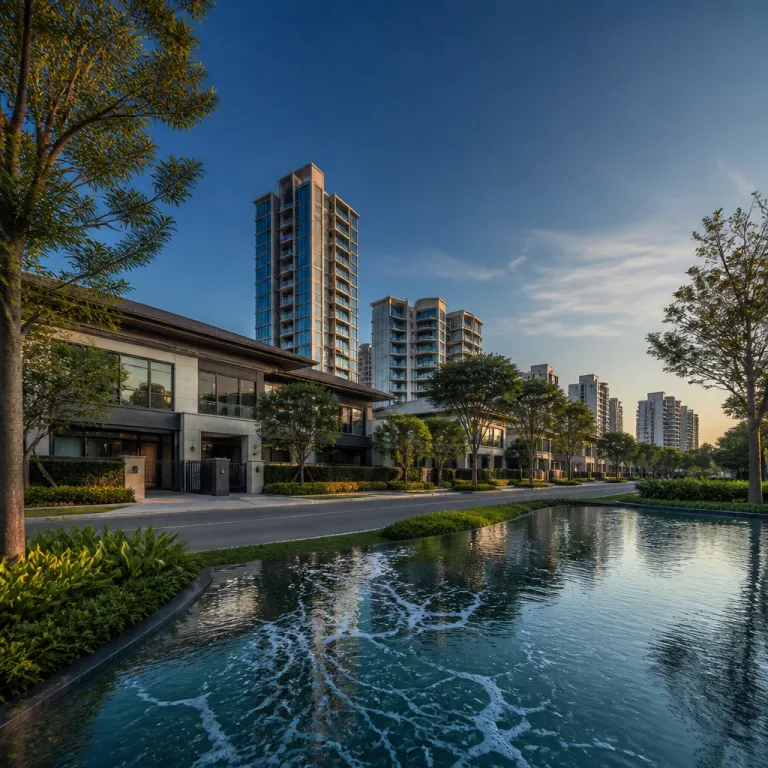
Singapore luxury real estate foreign buyers 2026 as a stress test for tax policy
Singapore sits at a rare intersection of luxury, regulation, and geopolitical calm. For the cohort often described as Singapore luxury real estate foreign buyers 2026, the city state functions less as a speculative market and more as a long term capital vault. When you examine how each international buyer behaves at the very top of the residential property market, you see that tax is a filter, not a deterrent.
The Additional Buyer’s Stamp Duty, or ABSD, at 60 percent for any foreign buyer without residency is among the highest buyer stamp surcharges on residential property globally. Yet in the ultra luxury bracket of private properties, especially along Orchard Boulevard and in Sentosa Cove, the property market still records transactions at 3,000 to 4,500 dollars per square foot, which tells you something about inelastic demand. According to Urban Redevelopment Authority (URA) caveats and widely reported transactions, for example, a unit at Les Maisons Nassim reportedly changed hands in 2022 at around S$5,800 per square foot, while a Good Class Bungalow in Nassim Road was reported in 2021 at over S$4,000 per square foot. For seasoned foreign buyers used to navigating every type of real estate tax regime, the question is not whether the stamp duty exists, but whether the underlying Singapore property justifies absorbing it.
In this context, the phrase Singapore luxury real estate foreign buyers 2026 is less a keyword and more a shorthand for a specific global cohort. These investors already hold residential properties in London, New York, Dubai, and Hong Kong, and they benchmark every new purchase against those markets. When they look at property Singapore wide, they see a safe, rules based estate market where the term risk is defined more by regulation than by volatility.
For this audience, the Singapore real estate proposition is simple yet powerful. Pay a high entry tax, accept a premium price for prime land, and receive in exchange a stable legal framework, low corruption, and a deep rental market. URA data indicates that private home rents rose by more than 30 percent between 2021 and 2023, reinforcing the income case even at elevated entry prices. As one private banker who advises several Asian family offices put it, “Our clients treat the ABSD as the price of admission to a jurisdiction where they trust the courts, the contracts, and the currency.” The result is that demand at the top end of luxury residential assets remains firm even as mid tier foreign buyers retreat in response to tighter loan limits, higher interest rates, and the same 60 percent ABSD that bites much harder at lower price points.
Orchard Boulevard and Sentosa Cove: tax proof micro markets
Orchard Boulevard has become the purest expression of how globally mobile capital in 2026 thinks about scarcity. Here, each luxury property is defined by more than its floor area; it is defined by its relationship to embassies, top hotels, and the central region retail spine. When an overseas buyer acquires a private residential property on this stretch, they are effectively buying into a curated ecosystem rather than a single asset.
Sentosa Cove tells a complementary story about landed property and water facing land in a tightly controlled estate market. The enclave remains one of the few places where a foreign buyer can purchase landed properties in Singapore, which makes every landed plot a strategic asset for those who value both privacy and yacht access. URA caveats show that waterfront bungalows there have transacted above S$2,000 per square foot on land area in recent years, even after the latest round of cooling measures. Even with ABSD at 60 percent, the combination of marina frontage, controlled supply, and ultra luxury positioning keeps demand resilient.
Transactions in these enclaves show that price sensitivity behaves differently once you cross a certain wealth threshold. For globally mobile investors focused on Singapore’s prime districts in 2026, the absolute price per square foot matters less than the long term security of the asset and the ability to integrate it into a global portfolio. That is why you still see high value purchases in both Orchard Boulevard towers and Sentosa Cove villas even when broader property news headlines focus on cooling measures and slower sales in the mass market and city fringe segments.
These micro markets also sit within a wider Asian luxuries circuit that includes Bangkok riverfront villas and Phuket headland estates. When you compare a Sentosa Cove villa to high end villas in Thailand, especially those highlighted in this analysis of the allure of high end villas in Thailand, you see how regulation and tenure shape perceived value. Singapore offers freehold or long leasehold certainty and clear stamp duty rules, while many Thai coastal properties involve more complex land structures.
Dubai, New York, and Singapore: three tax philosophies, one global buyer
When you map the behaviour of internationally active Singapore property investors in 2026, you inevitably end up comparing three hubs. Dubai offers zero income tax and no equivalent to a 60 percent ABSD, positioning itself as a low friction market for both residential and rental income. New York debates pied à terre taxes and mansion levies, while Singapore leans into high buyer stamp surcharges but low ongoing property taxes.
For ultra high net worth buyers, these differences are not theoretical; they are line items in a portfolio model. A foreign buyer might hold a penthouse in Dubai Marina for yield, a co op or condo in Manhattan for cultural access, and a Singapore luxury apartment in the central region for capital preservation and regional business anchoring. In that context, the Singapore ABSD becomes a one time cost of entry into a safe, regulated real estate hub rather than a recurring drag on returns.
New York’s proposed pied à terre tax, for example, targets non resident owners of high value properties with an annual levy. Dubai, by contrast, uses low transaction costs and zero income tax to attract both residents and non residents into its property market, especially in waterfront districts that echo the lifestyle of Sentosa Cove or Marina Bay. Singapore chooses a third path, using high ABSD on foreign buyers to manage demand while keeping ongoing holding costs relatively modest.
For globally diversified property owners looking at Singapore in 2026, the decision often comes down to how each jurisdiction balances transparency, rule of law, and lifestyle. A buyer who values regulatory clarity may accept a high purchase stamp duty in Singapore while using Dubai for tax efficient rental strategies and New York for cultural diversification. That same buyer might also look at other lifestyle markets such as Cabo, where the dynamics of luxurious condos in Cabo Mexico show how resort driven demand differs from a financial hub like Singapore.
The regulatory premium: why some buyers pay more for rules
There is a concept that every serious investor in high end Singapore property should internalize. Call it the regulatory premium, the extra price per square metre that foreign buyers are willing to pay for a predictable legal environment. In Singapore, that premium is visible not only in Orchard Boulevard towers but also in tightly held Marina Bay residences and select central region projects.
For many foreign buyers, especially those from jurisdictions with weaker legal protections, the certainty of Singapore’s courts and land registry is worth a significant upfront cost. They accept a high ABSD and a steep initial purchase price because they expect fewer unpleasant surprises over the long term, whether in zoning, title disputes, or sudden policy reversals. In effect, they are capitalizing the value of trust into the real estate price they pay today.
This is where globally mobile capital at the top end of the Singapore market diverges from more price sensitive segments of the estate landscape. A mid level investor might balk at a 60 percent buyer stamp surcharge on a private apartment, but an ultra high net worth family office may view it as a screening mechanism that keeps speculative froth out of their building. The result is a residential property ecosystem where the top tier remains relatively insulated from short term policy shifts, even as URA statistics show slower resale volumes and softer price growth in some mass market and city fringe projects after each round of cooling measures.
That regulatory premium also extends to how the Singapore property market handles information. Property news is disseminated quickly, transaction data is relatively transparent, and enforcement of rules around rental, land use, and foreign ownership is consistent. For an owner already holding assets in more opaque markets, this transparency can justify allocating more capital to property Singapore wide, even when headline taxes appear punitive.
There are limits, however, to how far this premium can stretch. A handful of ultra prime launches have tested buyer patience when pricing raced ahead of perceived value, leading to slower take up despite the Singapore brand. These counterexamples underline that while investors will pay more for rules, they still benchmark every purchase against alternatives in other global cities.
Beyond the skyline, the same logic applies to waterfront and riverfront assets, where planning controls preserve view corridors and public access. When you evaluate exceptional riverfront homes, such as those profiled in this piece on the elegance of riverside living, you see how carefully managed land and water interfaces command a premium. Singapore’s Marina Bay and river facing districts follow a similar script, reinforcing the idea that well regulated waterfronts are among the most resilient real estate sub markets.
Residency pathways, portfolio strategy, and lessons for other markets
One reason the behaviour of high end foreign purchasers in Singapore remains a relevant lens for 2026 is that the tax burden is not static. Once a foreign buyer becomes a permanent resident, the ABSD rate drops significantly, changing the effective blended tax across a multi property holding period. For ultra high net worth families, this creates an incentive to think in decades rather than years.
In practice, many foreign buyers structure their entry into the Singapore property market with this residency pathway in mind. They may accept a single high ABSD hit on an initial luxury residential purchase in the central region, then plan subsequent acquisitions as their status evolves and their buyer stamp obligations fall. Over a long term horizon, the effective tax rate on their estate can look far less punitive than the headline 60 percent suggests.
For policymakers in other cities considering luxury property taxes, the Singapore case offers a clear lesson. If your goal is to cool speculative demand without driving away serious capital, you need to differentiate between short term trading and long term ownership, much as Singapore does through its mix of ABSD, seller stamp duties, and residency linked rules. Blunt annual levies that treat every foreign buyer the same risk pushing the most disciplined capital to more predictable jurisdictions.
For you as an exclusive estate owner, the message is equally direct. When you evaluate globally active Singapore focused buyers in 2026 as part of your wider allocation, focus less on the headline tax and more on how the combination of regulation, land scarcity, and rental depth shapes total return. In a world where political risk can reprice assets overnight, paying a premium for a tightly run, rules based estate market can be a rational, even conservative, strategy.
FAQ
How does the 60 percent ABSD affect ultra prime pricing in Singapore ?
The 60 percent Additional Buyer’s Stamp Duty significantly raises the entry cost for any foreign buyer without residency, but it has not forced down prices in the ultra prime segment. In districts such as Orchard Boulevard, Marina Bay, and Sentosa Cove, scarcity of land, strong international demand, and the perceived safety of the Singapore real estate system keep prices in the 3,000 to 4,500 dollars per square foot range. URA price indices for the Core Central Region have remained resilient even after successive cooling measures, and for ultra high net worth buyers the ABSD is treated as a one time cost of accessing a stable, regulated hub.
Why do foreign buyers still choose Singapore over lower tax markets like Dubai ?
Foreign buyers who prioritize regulatory certainty and political stability often accept Singapore’s high buyer stamp surcharges in exchange for a transparent legal framework and predictable policy environment. Dubai’s zero income tax and lower transaction costs are attractive for yield and lifestyle, but some investors view Singapore as a safer long term store of wealth. Many global portfolios include both markets, using Dubai for tax efficient rental strategies and Singapore for capital preservation.
Can foreign buyers purchase landed property in Singapore ?
Foreign buyers face strict limits on landed property in Singapore, with Sentosa Cove being the primary enclave where non citizens can buy landed homes subject to approval. This scarcity makes landed properties in that area particularly sought after among globally mobile buyers focused on Singapore in 2026. On the mainland, most foreign buyers focus on private apartments and luxury residential units in the central region.
How does residency status change the tax position for foreign buyers ?
When a foreign buyer becomes a Singapore permanent resident, their ABSD rate on subsequent residential property purchases typically falls compared with the 60 percent rate applied to non residents. Over a long term holding period and multiple acquisitions, this can materially reduce the blended tax burden on a portfolio. Many ultra high net worth families therefore view an initial high tax purchase as a strategic step toward a more efficient long term position.
What can other cities learn from Singapore’s approach to taxing luxury real estate ?
Other cities can observe that high transaction taxes, when paired with strong rule of law and clear residency pathways, do not necessarily drive away serious capital. Singapore’s experience shows that differentiating between speculative, short term activity and committed, long term ownership is crucial when designing property taxes. Markets that impose blunt, recurring levies on all non resident owners risk losing disciplined investors to more predictable jurisdictions.