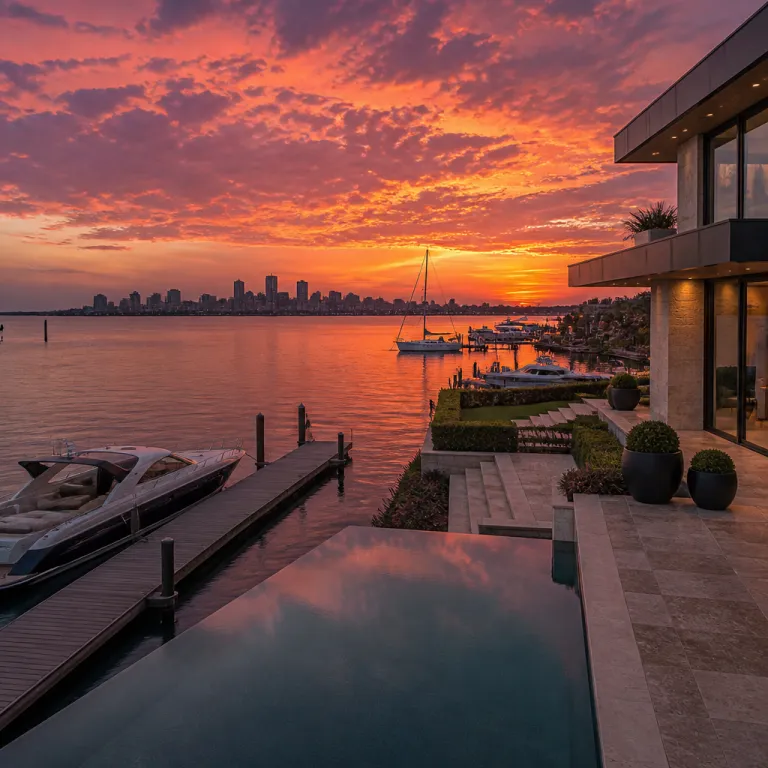
Where the 44% surge is really landing in america
Foreign buyers in US luxury real estate in 2026 are not scattering capital evenly across the estate market. They are concentrating on a handful of coastal and tax efficient enclaves in North America where liquidity, lifestyle and legal clarity intersect for affluent buyers. For an existing estate owner, understanding this geographic pattern is the first key to positioning your own luxury properties within a shifting global luxury landscape.
Florida absorbs a disproportionate share of international purchasers at the high end, with Miami, Palm Beach and Fort Lauderdale acting as the primary estate gateways for capital from Europe, Asia and the Middle East. In Miami, the blend of international real finance, crypto friendly developers and tower projects by architects such as Herzog & de Meuron has turned specific property type segments into a de facto offshore balance sheet for high net worth individuals. The Fort Lauderdale waterfront, recently highlighted as a bellwether in the luxury comeback nobody expected, shows how a single record USD land sale can reset market analysis benchmarks for every nearby estate.
On the opposite coast, California’s luxury real estate corridors from Pacific Palisades to Silicon Valley continue to attract overseas money from buyers who treat prime property as both a primary residence and a technology adjacent investment. Here, the estate market is driven less by speculative sales volume and more by constrained inventory, zoning limits and the gravitational pull of global technology wealth from Asia and the Middle East. New York and Texas complete the quartet of key destinations, with New York favored for its deep international real liquidity and Texas for its tax structure, land availability and diversified property type options across ranch, urban tower and gated golf estate formats.
Within these states, the real story lies in micro markets rather than broad state lines, because affluent cross border purchasers are targeting specific school districts, marina access points and private aviation hubs. A waterfront estate in Coral Gables, a brownstone in Brooklyn Heights and a hilltop compound in Austin’s Westlake each sit in very different market analysis universes, even if their headline USD values appear similar. Owners who track these micro trends can time sales, refinancings and portfolio reallocations with far more precision than those who only follow national real estate headlines.
Source countries, motivations and the dual use primary residence
The 44% rise in foreign buyers in US luxury real estate in 2026 is being driven by a tight cluster of source regions rather than a diffuse global crowd. According to recent National Association of Realtors data on international transactions in U.S. residential real estate, capital from Asia, the Middle East and selected parts of Europe is converging on North America for reasons that go well beyond lifestyle marketing. For many high net worth individuals, the U.S. estate market now functions as both a geopolitical hedge and a family infrastructure strategy.
Buyers from Asia often frame a U.S. luxury property as a long term education and succession planning asset, choosing a primary residence near universities in Boston, New York or California while maintaining investment estates in cities like London, Madrid or Barcelona in Spain. Families from the Middle East and Europe frequently pursue a dual use model, holding one primary residence in their home jurisdiction and a second or third property type in America that operates as both a pied à terre and a hard asset denominated in USD. This dual use pattern is reshaping luxury real sales, because it creates stickier ownership cycles and fewer forced sales during short term market volatility.
Wealth preservation remains the dominant motivation, but lifestyle and mobility now sit almost equal in the hierarchy for affluent buyers. A Gulf family may acquire a Los Angeles estate for its climate, private school network and direct flights, while a Latin America entrepreneur might prefer a Miami penthouse for its international realty ecosystem and proximity to regional headquarters. In both cases, the estate is less a trophy and more a node in a global luxury life, connecting America, Europe, Asia and the Middle East through one coherent property portfolio.
For existing owners, the implication is clear; you are no longer competing only with neighboring estates, but with alternative destinations such as riverfront compounds in the American South or waterfront villas in Mexico. Articles on exceptional homes on rivers for sale show how inland waterfront property type segments are quietly attracting foreign buyers who once focused solely on coastal towers. When you calibrate your own estate positioning, you should think in terms of a global report of options that your future buyer is weighing, not just the local ZIP code.
Crypto wealth, transparency rules and the new face of luxury real capital
One of the most misunderstood drivers behind cross border demand for high end U.S. property is the role of crypto and digital wealth. In markets like New York, Miami and parts of California, early crypto investors have converted volatile tokens into tangible luxury properties, often in all cash USD transactions. This has created a parallel estate market where technology driven fortunes meet traditional brick and stone, and where regulatory scrutiny is rising just as fast as sales.
FinCEN’s beneficial ownership reporting rules now require that all cash entity purchases in many U.S. jurisdictions disclose the real individuals behind the buying structure. For foreign buyers, this shift has turned what was once a discreet estate acquisition into a more transparent process that must align with tax, compliance and reputation strategies across America, Europe, Asia and the Middle East. The days when a shell company could quietly acquire a waterfront estate in North America without leaving a regulatory footprint are effectively over, and sophisticated market analysis now treats transparency risk as a core part of the investment thesis.
Crypto linked buyers have adapted by working more closely with international realty firms and private banks that understand both digital asset custody and cross border real estate structuring. Brands such as Sotheby’s International Realty, often referred to in shorthand as sotheby international in market commentary, have built specialist équipes that can translate volatile token valuations into stable USD purchase capacity for luxury properties. For an existing owner, this means that a portion of your future buyer pool will arrive with unconventional balance sheets, but with highly professional advisers who expect institutional grade documentation, title clarity and a clean compliance trail.
At the same time, the narrative that crypto alone is inflating every estate price is too simplistic, because the 44% surge in foreign buyers in US luxury real estate in 2026 is also grounded in a broader global luxury wealth cycle. A multi trillion USD intergenerational wealth transfer, highlighted in recent Sotheby’s International Realty Luxury Outlook reporting, is pushing younger, technology fluent heirs to rebalance portfolios toward tangible assets, including riverfront estates, ski properties and coastal compounds. The recent attention on Fort Lauderdale’s high profile land transactions, captured in coverage of the unexpected luxury comeback, illustrates how quickly a single data point can reset expectations for both crypto rich and traditionally wealthy buyers.
Currency exposure, valuation discipline and cross border portfolio strategy
For an exclusive estate owner, the most overlooked aspect of catering to international purchasers is currency exposure. When your buyer’s net worth is denominated in euros, pounds, dirhams or yuan, every USD price tag carries an embedded foreign exchange bet. Sophisticated high net worth individuals treat this not as background noise but as a central part of their real estate investment analysis.
Owners in America who also hold estates in Europe or Spain, for example, increasingly view their portfolio through an America Europe lens, balancing USD assets against euro denominated luxury properties in Madrid, Barcelona or the Balearic Islands. Those with holdings in Asia or the Middle East often adopt an America Asia framework, using U.S. estates as a stabilizing anchor when regional currencies or political climates feel less predictable. In both cases, the estate market becomes a de facto currency hedge, and the timing of sales or acquisitions is often aligned with foreign exchange cycles rather than local open house chatter.
Practical portfolio management now means stress testing your estate valuations under different currency scenarios, especially if you expect foreign buyers to feature prominently in your exit strategy. A penthouse in New York priced at 10 million USD may feel very different to a euro based buyer when the exchange rate moves ten percent in either direction, and that shift can alter both demand and negotiation dynamics. Owners who coordinate with private banks and international real advisers can structure staggered sales, partial refinancings or cross collateralized loans that respect both local market conditions and global currency realities.
There is also a lifestyle dimension to this financial engineering, because many affluent buyers treat their U.S. estate as a flexible primary residence that can be dialed up or down in usage depending on tax residency, schooling and business needs. A family might spend nine months a year in America and three months in Europe, while holding a smaller pied à terre in Asia to maintain business ties and optionality. For those exploring additional diversification, curated guides to destinations such as exceptional homes for sale in Tulum, Mexico show how non U.S. assets can complement a North America base, creating a genuinely global luxury footprint.
How foreign concentration reshapes pricing, culture and exit options
When foreign buyers in US luxury real estate in 2026 cluster in specific neighborhoods, they do more than lift headline prices. They change the cultural fabric, the service ecosystem and the very definition of what a luxury property should offer. For existing owners, this concentration can either amplify your estate’s appeal or quietly narrow your future buyer pool.
In Miami’s waterfront corridors, for example, a high share of foreign buyers has pushed developers to prioritize marina berths, multilingual concierges and technology rich security systems that match expectations from Asia, Europe and the Middle East. In Los Angeles, the influx of international real capital has encouraged architects to blend Californian indoor outdoor living with design cues from Mediterranean estates in Spain and contemporary compounds in Dubai, creating a hybrid luxury real aesthetic. New York’s prime co ops and condos, by contrast, still filter foreign demand through strict board approvals and financial disclosure standards, which can slow sales but preserve a particular cultural and architectural character.
From a pricing perspective, concentrated foreign demand can create sharp upswings followed by long plateaus, especially in micro markets where new supply is constrained by zoning or geography. A waterfront estate in Palm Beach or a riverfront townhouse in a historic American city may see rapid valuation growth when a wave of affluent buyers arrives, then years of sideways movement as that cohort holds rather than trades. Owners who understand this cycle can plan exits around liquidity windows rather than arbitrary timelines, aligning with the forecast patterns highlighted in every serious global luxury report.
Strategically, you should think of your estate not only as a single asset but as part of a narrative that appeals to a specific international buyer archetype. Some will prioritize privacy and low profile ownership structures that comply with FinCEN rules while still offering discretion, while others will seek branded residences linked to international realty networks and hospitality names. If your property type, location and amenity mix speak clearly to one of these profiles, your odds of capturing the most motivated segment of foreign buyers in US luxury real estate in 2026 rise significantly, and your estate becomes a deliberate choice rather than just another listing in a crowded market.
FAQ
Which US markets are currently most attractive to foreign luxury buyers ?
Foreign buyers in US luxury real estate in 2026 are concentrating on Florida, California, Texas and New York, with micro markets such as Miami, Palm Beach, Fort Lauderdale, Los Angeles, Austin and prime Manhattan neighborhoods absorbing a large share of global capital. These areas combine liquidity, lifestyle infrastructure, tax advantages and established international realty networks that make them natural hubs for high net worth individuals. Within each state, specific waterfront, hilltop or urban districts behave as distinct estate markets with their own pricing and demand cycles.
How do FinCEN beneficial ownership rules affect foreign buyers and sellers ?
FinCEN’s beneficial ownership reporting requirements mean that many all cash purchases through entities must now disclose the real individuals behind the structure. For foreign buyers, this increases the need for coordinated legal, tax and compliance planning across jurisdictions, and it reduces the appeal of opaque holding companies. For sellers, the rules favor well documented estates with clear title histories and transparent ownership records, because sophisticated buyers and their advisers now treat regulatory clarity as a key part of their investment analysis.
What role does crypto play in current US luxury real estate transactions ?
Crypto wealth influences US luxury real estate primarily by converting digital assets into USD before closing, rather than through direct coin to property swaps. Early crypto investors have become a visible segment of foreign buyers in cities like Miami, New York and Los Angeles, often working with private banks and international realty firms to manage volatility and compliance. For estate owners, this means a portion of the buyer pool may have unconventional wealth sources but highly professional advisory teams and strong expectations around documentation and security.
How should an existing owner prepare a property for an international buyer audience ?
Owners targeting foreign buyers in US luxury real estate in 2026 should focus on three pillars : documentation, infrastructure and narrative. Documentation means impeccable title, clear zoning, recent inspections and transparent operating costs, all packaged in a way that global advisers can review quickly. Infrastructure includes security, connectivity, staff accommodation and access to schools, airports and marinas, while narrative means positioning the estate within a global portfolio context that resonates with the specific lifestyle and investment goals of affluent buyers from Asia, Europe or the Middle East.
How does currency fluctuation impact pricing and negotiation with foreign buyers ?
Currency movements can materially change how expensive a USD priced estate feels to a euro, pound, yuan or dirham based buyer, sometimes by double digit percentages over a short period. Sophisticated high net worth individuals and their advisers monitor these shifts closely and may accelerate or delay acquisitions based on foreign exchange conditions. Sellers who understand this dynamic can time listings, accept staged payments or structure price discussions in ways that align with the buyer’s currency reality while still protecting their own long term value objectives.
Sources
Sotheby’s International Realty – Luxury Outlook report (2024 edition, global wealth and cross border luxury housing trends).
National Association of Realtors – Profile of International Transactions in U.S. Residential Real Estate (2023–2024 data on foreign buyer volumes and origin countries).
FinCEN – Beneficial Ownership Information Reporting Rule (effective January 1, 2024, expanding transparency for entity purchasers in U.S. real estate).