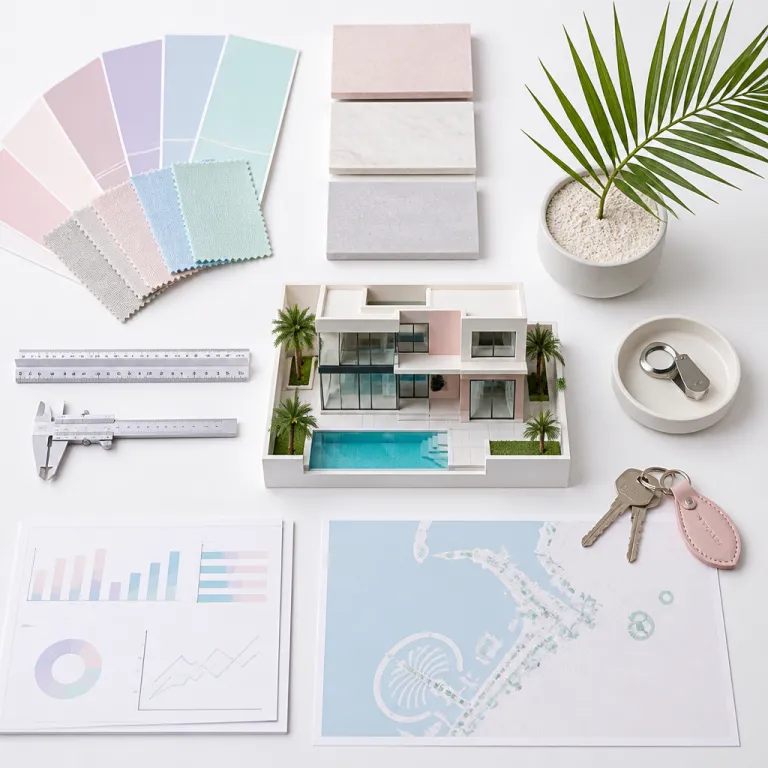
The Dubai luxury market after the surge: from momentum to discipline
Dubai has moved from a speculative sprint to a measured stride. The high-end residential sector in H1 2026 now sits at the inflection point where exuberant villa gains of roughly 206 percent over the last cycle meet a more rational estate market shaped by data, end users, and stricter capital. For an exclusive estate owner, this is the moment when real pricing power shifts from hype to fundamentals in both the luxury residential segment and the broader property market.
According to Dubai Land Department (DLD) transaction statistics and aggregated brokerage and consultancy dashboards for the 12 months to mid‑2026, residential sales in Dubai fell from about 91,973 to 79,281 deals, while total estate transaction value slipped from roughly AED 262.6 billion to AED 221.4 billion. That 13.8 percent drop in volume and 15.7 percent decline in sales AED value signals cooling but not collapse. This contraction in transaction volume is precisely what a maturing Dubai real estate cycle looks like, because weaker speculative property trades are flushed out while higher quality residential sales and long term investment capital remain. In practice, the luxury housing market in H1 2026 shows fewer impulsive flips, more structured payment‑plan based acquisitions, and a clearer separation between trophy properties and commodity stock across the estate market.
For you as a global portfolio holder, the key is to read this report‑style data not as a warning but as a filter. A market performance phase where demand normalizes and the average price per square foot stabilizes often creates better entry points for luxury properties than the frenzy that preceded it. The current Dubai prime residential landscape therefore rewards buyers who treat each Dubai property as a business, calibrating price per square foot, yield, and foreign investment exposure rather than chasing headline “worth‑billion” narratives. At the same time, you should recognize that any data‑driven view is backward looking by definition, and factor in the possibility that new regulations, financing costs, or geopolitical shifts could still alter the trajectory of the next cycle.
Why a volume drop can be healthy: anatomy of a maturing cycle
Headline writers focus on the 13.8 percent fall in residential sales volume, but serious capital should focus on what vanished and what stayed. In the upper tier of the Dubai housing market during H1 2026, there has been a clear retreat of short term speculators who once treated every off‑plan launch as a lottery ticket, while end user demand and institutional investment have proven far more resilient. That shift is visible in the mix of estate transactions, where bulk flips have thinned but high quality luxury acquisitions in prime districts still clear at firm price levels.
When a market moves from exuberance to selectivity, liquidity narrows but depth improves, and Dubai is no exception. The current property market shows fewer small ticket transactions chasing quick gains, yet the aggregate AED‑billion value of serious deals remains substantial, underpinned by foreign investment from Europe, Asia, and the Gulf that views Dubai real assets as a tax efficient, globally connected hedge. For an exclusive estate owner, this means you can negotiate more intelligently on individual properties without fearing systemic distress in the wider estate market.
In this phase, your plan should prioritize quality of entry over speed of deployment. Study each sub‑market’s report‑style data on average price per square foot, rental demand, and long term infrastructure commitments before adding any Dubai property to your portfolio. The luxury segment in H1 2026 rewards buyers who behave more like the ultra‑prime investors on Singapore’s Orchard Boulevard, where high stamp duties reshaped but did not kill demand, a dynamic explored in depth in this analysis of luxury inelasticity on Orchard Boulevard and other constrained global corridors. Methodology for this comparison relies on achieved transaction prices, not asking prices, and focuses on repeat‑sale evidence in tightly supplied streets.
The supply wall: 83,000 completions and what they mean for pricing power
Roughly 83,000 new residential units are scheduled to complete over the 2025–2026 window, almost double the handovers of the previous year, based on developer release calendars, DLD project registration data, and delivery guidance from major brokerages. That surge in supply intersects with the high‑end Dubai residential market at a delicate moment, because estate transactions are already moderating while developers race to deliver properties sold during the boom. For a sophisticated owner, the question is not whether this supply wall exists, but where it will genuinely pressure price and where it will simply broaden choice without crushing the luxury real segment.
Most of the 150,000‑plus units launched recently are scheduled for delivery closer to the next cycle, which means the immediate impact concentrates in specific corridors such as Dubai South, emerging suburban clusters, and mid‑market apartment belts. In those areas, the average price per square foot and the average AED value of transactions may soften as buyers gain leverage, especially for commodity stock that lacks waterfront, branded hospitality, or strong community infrastructure. By contrast, tightly supplied luxury properties on the Palm Jumeirah, Jumeirah Bay, and select golf estates are less exposed, because their land constraints and global appeal limit effective competition even when the broader property market faces a wave of completions.
To illustrate how this plays out on the ground, consider recent DLD‑recorded sales in Q2 2026:
| Micro‑market | Development (example) | Asset type | Achieved price/sq ft (AED) |
|---|---|---|---|
| Palm Jumeirah | Six Senses Residences | Branded waterfront apartment | 6,000–7,200 |
| Jumeirah Bay Island | Custom villa plots | Ultra‑prime villa | 8,500–10,000 |
| Dubai South | Mid‑rise freehold cluster | Mid‑market apartment | 1,050–1,350 |
These ranges, drawn from recent transaction reports and smoothed to remove outliers, show how constrained‑supply waterfront and island assets retain pricing power even as more generic stock in supply‑heavy corridors trades at a discount.
For you, the strategic move is to map your holdings and targets against this supply pipeline with the same rigor you would apply to a World Cup host city or a new financial hub. The evolving Dubai luxury landscape in H1 2026 should be read alongside other global catalysts, such as how major sporting events reshape prime values, as examined in this detailed look at how host cities alter luxury property values over time. In practice, that means leaning into rare land, proven communities, and low future supply, while demanding sharper price‑per‑square‑foot discipline when negotiating in heavily supplied Dubai South and similar districts.
Yield, end users, and the new hierarchy of returns
Average gross residential yield in Dubai sits around 6.58 percent, with apartments at roughly 6.9 percent, townhouses near 5.1 percent, and villas around 4.5 percent, based on blended figures from major brokerage yield trackers and DLD rental registration data for the 12 months to mid‑2026. In a tax‑free jurisdiction, those yields place Dubai’s upscale real estate firmly on the global radar, especially when compared with prime London or Paris, where net yields on luxury properties often struggle to reach half those levels. The nuance for an exclusive estate owner is that headline yield masks a sharp divergence between sub‑markets, asset quality, and tenant profiles across the estate market.
End user purchases now dominate many prime communities, replacing the speculative flips that once inflated both volume and price, and that shift has implications for both liquidity and rental demand. Where owner‑occupiers anchor a community, the average price per square foot tends to be more resilient in downturns, but rental yields may compress as fewer units chase high income tenants, particularly in ultra‑prime villa enclaves whose AED‑billion valuations rely more on lifestyle than on pure income. In contrast, well located apartments in business districts and waterfront towers continue to attract strong foreign investment, supporting both rental demand and stable estate transaction volume even as the broader property market cools.
For portfolio construction, this means treating villas as long term capital preservation plays and apartments as yield engines, rather than expecting every Dubai property to do everything at once. The current luxury cycle favors owners who separate lifestyle holdings from income assets, calibrating leverage, tenancy strategy, and exit timing accordingly. If you are acquiring a waterfront mansion or ultra‑prime villa, you should apply the same rigorous due diligence used for oceanfront estates worldwide, including the kind of legal, technical, and environmental checklist outlined in this comprehensive due diligence guide for oceanfront mansion buyers. Yield calculations in this context should be based on net achievable rent after realistic vacancy, service charges, and maintenance, not on optimistic brochure projections.
Developer quality, micro locations, and how selective buyers should act now
After a 206 percent villa price surge, developer quality and delivery track record have become the real currency of trust. The upper‑tier Dubai residential market in H1 2026 is no longer forgiving of weak balance sheets, over‑ambitious master plans, or vague completion timelines, because sophisticated buyers now interrogate every report, every escrow structure, and every construction milestone. In this environment, the estate market rewards those who prioritize audited histories of on‑time delivery, transparent service charge regimes, and robust post‑handover support.
Micro location has also moved from lifestyle preference to financial determinant, as two properties with similar size and finish can show radically different market performance depending on access, community maturity, and future infrastructure. A villa in a fully established golf estate with proven residential sales history, international school access, and stable service charges will command a different price per square foot than a similar home in a still‑emerging Dubai South cluster, even if both are marketed as luxury real offerings “worth‑billion” AED on paper. For an exclusive estate owner, that means underwriting each Dubai property at the level of the square foot, not the brochure, and stress‑testing both exit liquidity and rental demand under less generous assumptions.
Your playbook now should be precise rather than broad. Focus new investment on best‑in‑class properties within proven communities, negotiate assertively where supply is heavy and estate transactions have slowed, and be willing to walk away when price‑per‑square‑foot expectations ignore the new reality of Dubai’s high‑end residential market in H1 2026. Over the long term, the portfolios that outperform will be those that treated this phase not as the end of a boom, but as the beginning of a more disciplined, globally credible Dubai real estate chapter, where AED‑billion valuations are earned rather than assumed.
FAQ
Is the Dubai luxury market in a bubble after the 206 percent villa surge ?
Villa prices have risen sharply, but the latest H1 2026 data from DLD and major consultancies shows signs of maturation rather than imminent collapse. Transaction volume and total AED sales value have both moderated, speculative flipping has declined, and end user and institutional investment now anchor many prime communities. Those dynamics are more consistent with a market normalizing after a rapid repricing than with a classic bubble about to burst.
Where are yields most attractive for high end investors in Dubai ?
On average, apartments in Dubai currently offer higher gross yields than villas, with typical figures near 6.9 percent for apartments versus around 4.5 percent for villas, based on 2025–H1 2026 yield surveys. In the city’s luxury and upper‑mid segments, well located apartments in business districts and established waterfront towers often provide the best balance of yield, liquidity, and tenant depth. Villas and ultra‑prime estates tend to function better as long term capital preservation and lifestyle assets than as pure income generators.
How should I think about the 83,000 upcoming unit completions ?
The large pipeline of completions will not affect every segment equally. Mid‑market and emerging areas such as parts of Dubai South are more exposed to pricing pressure, while tightly supplied luxury enclaves with limited new land, such as Palm Jumeirah or Jumeirah Bay, are relatively insulated. For a sophisticated buyer, the key is to map each target property against future supply in its immediate micro‑market, using DLD project data and developer delivery schedules, before committing capital.
Are off plan purchases still attractive for luxury buyers ?
Off‑plan opportunities remain viable, but only with top tier developers who have strong delivery records, transparent escrow arrangements, and realistic construction timelines. In the H1 2026 luxury environment, buyers should scrutinize every plan, contractor, and financing structure, and avoid projects that rely on aggressive price growth assumptions to justify AED‑billion valuations. End user driven communities with phased, well funded development remain the safest off‑plan bets.
What is the single most important metric to track before buying now ?
For most ultra high net worth buyers, the most useful single metric is the achieved price per square foot for comparable recent estate transactions in the same micro location, as recorded by DLD. In the current Dubai luxury cycle, that figure reveals far more about true market performance than asking prices or glossy marketing narratives. Combine that data with realistic rental demand assumptions and a clear long term holding plan to calibrate both entry price and exit strategy.